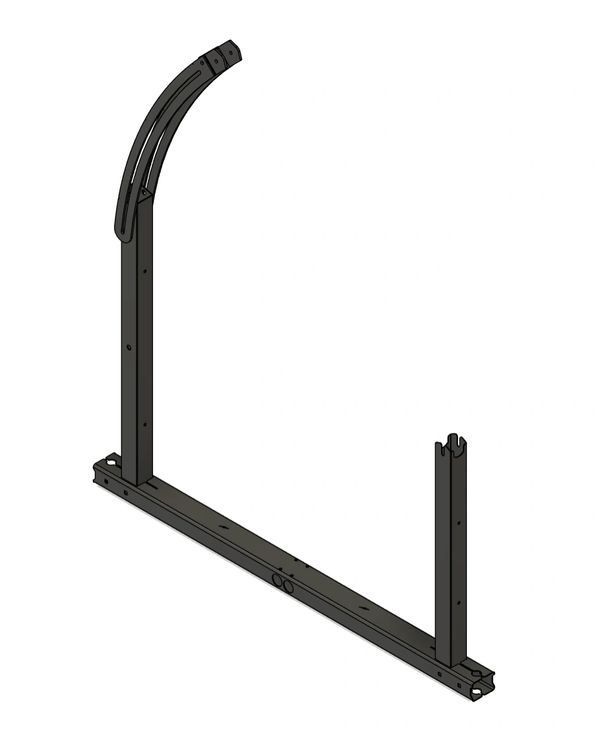
Our IR EarthBallast mounting option is ideal for most terrain types, particularly when excess soil or crushed rock is available on-site. The geotextile fabric creates a trampoline effect when it's pulled tight and has a minimum 2" air gap above the ground before the soil or rock is placed on the geotextile fabric. This is what creates the down force for holding the frames down in high wind situations.
A skid-steer loader or tractor can be used to evenly distribute earth fill over the included geotextile material that is stretched across and epoxied to the top of each solar rack frame prior to the solar panels being installed, creating a strong heavy ballast with a clean and natural look when completed. The EarthBallast system can also be used with sand bags for ballast.
PRO TIP: Ballast with light sand or crushed light colored rock for increased bifacial gain
*1" Conduit Pipe / EMT (NOT included) is required to link the frames together and can be sourced at any local hardware or electrical supply store. Our Base Tube Composite Pipe can also be used instead of EMT.
*We recommend using this system with two 3/4" round concrete forming steel stakes for each frame to provide added strength and easy leveling of the system.
IntegraRack “BallastRack” solar panel racking frames, when ballasted in accordance with our published data sheets, are considered temporary/movable retail finished, pre-engineered backyard accessory fixture. Therefore, according to IBC, they do not require a building permit, so long as the racking fixture is not over 5 feet 9 inches (1753 mm) in height (see Chapter 1, Section [A] 105.2 of the 2018/2021/2024 International Building Code (IBC®)). Furthermore, the BallastRack solar panel rack frames can also be used for the storage of tools, water tanks, or other storage items, while utilizing the solar panels themselves as the weather shelter.
*If you need to achieve a higher wind speed rating for your installation, you might want to consider our Concrete BallastSlab™ mounting option.
*In some counties, anchoring the system with bolts, on concrete footings, or other anchoring systems may require engineering and/or a building permit.
*Some counties may have different requirements for classifying temporary structures. Please check with your local Authority Having Jurisdiction (AHJ).